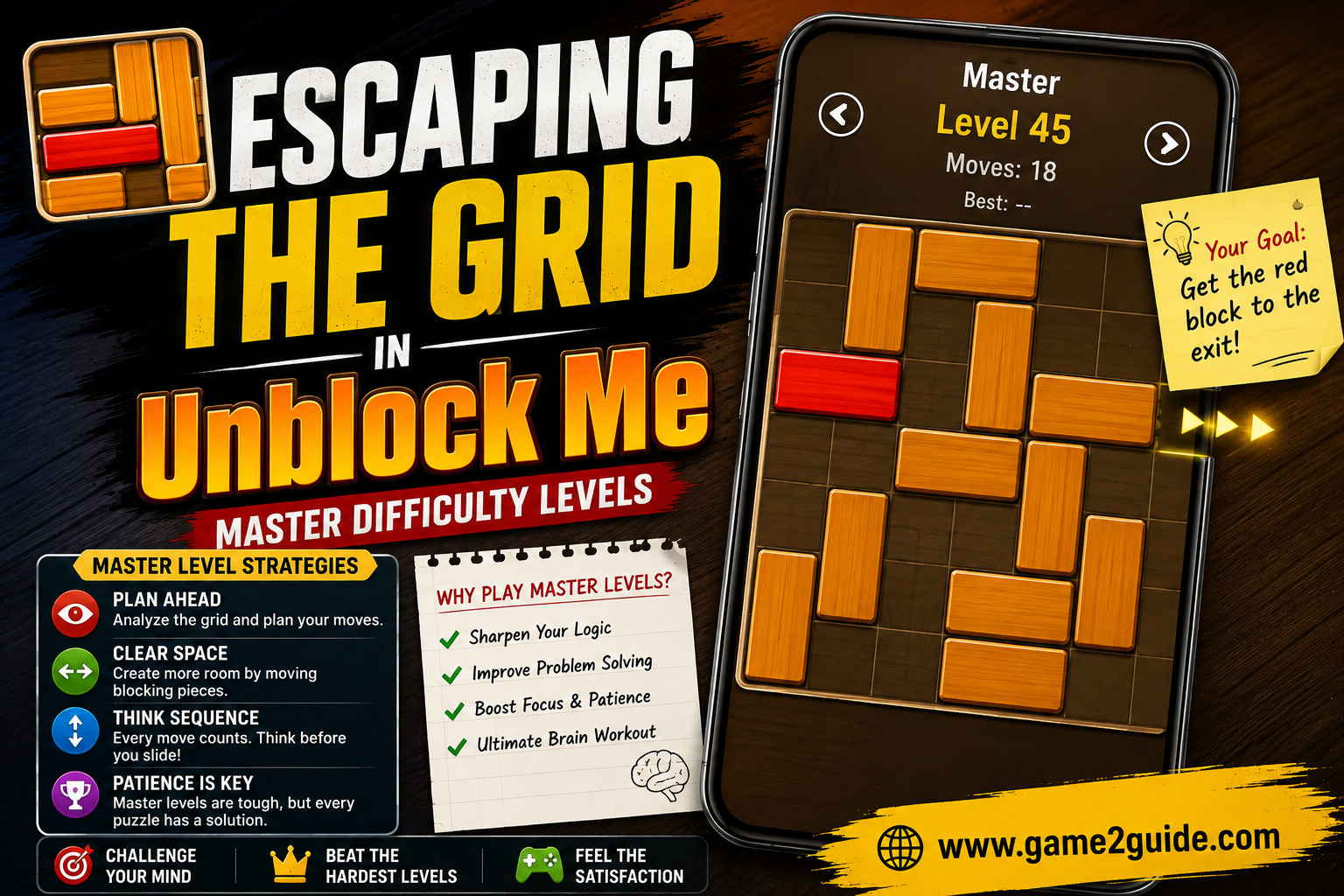
Sliding a block one square in Unblock Me feels harmless enough, right until you realize it just locked your red block behind three others with no way out. Master difficulty levels punish careless moves in a way beginner and intermediate boards never do, and a lot of players hit a wall the moment the grid stops feeling like a casual time-killer. This game have 4.89 stars, 50M+ downloads.
This guide covers exactly what it takes to start escaping the grid in Unblock Me consistently at master difficulty, including how to plan moves in advance, avoid dead-end traps, and think several steps ahead instead of shuffling blocks reactively.
Why Master Difficulty Feels So Different From Easier Levels
Beginner and intermediate Unblock Me boards usually allow a fair amount of trial and error without serious consequences. Master difficulty removes that safety net almost entirely. A single careless slide can lock the red block behind a wall of pieces with no legal path to reverse the mistake without undoing several moves.
The core skill needed here is not speed. It is forward planning. Master boards are designed so that the obvious first move is often the wrong one, and players who rush in without scanning the full grid first tend to trap themselves within the first few slides.
Read the Entire Grid Before Moving a Single Block
The single most important habit for master-level success is resisting the urge to move anything until you have studied the full board layout.
Identify the Direct Path First
Before touching any block, trace the shortest theoretical path the red block would need to reach the exit if no obstacles existed. This gives you a baseline understanding of which blocks are actually standing in the way versus which ones are irrelevant to the solution entirely.
Separate Relevant Blocks From Decoys
Not every block on a master-difficulty grid needs to move. Some pieces sit completely out of the red block’s eventual path and exist purely to clutter your thinking. Spend a moment identifying which blocks genuinely intersect the exit path before planning any moves around them.
Core Strategies for Solving Master-Level Boards
Once you have a read on the grid, these techniques consistently help untangle even the most tightly packed master boards:
- Work backward from the exit occasionally. Instead of only planning forward from the red block’s starting position, consider what the grid needs to look like immediately before the final winning slide, then work backward from there.
- Move blocking pieces to their most flexible position, not just out of the way. A block moved carelessly out of one path often ends up blocking a different necessary path later in the solution.
- Prioritize vertical blocks before horizontal ones when they intersect the main path. Vertical blocks often have fewer safe repositioning options, so addressing them earlier prevents them from becoming immovable obstacles later.
- Count available empty squares before committing to a multi-step maneuver. Master boards frequently have exactly enough open space for one specific sequence, and miscounting leads to a stuck position requiring a full restart.
- Undo early if a sequence starts feeling forced. If you find yourself needing an impossible move to continue, it is almost always faster to undo several steps than to keep pushing forward hoping something opens up.
Avoiding Common Dead-End Traps
Master difficulty grids are specifically designed to punish a handful of predictable mistakes. Recognizing these traps before they happen saves significant time.
The Premature Slide Trap
Moving a block out of the way immediately, simply because it is possible, often locks it into a position that blocks a different block later. Before making a move just because it is available, confirm it does not create a new obstacle somewhere else in the eventual path.
The Single-Direction Tunnel Vision Trap
Focusing entirely on clearing a horizontal path while ignoring vertical blocks stacking up nearby is a common mistake on complex boards. Periodically check the entire grid rather than narrowing your focus onto just the row or column you are currently working through.
Building a Repeatable Solving Process
Rather than approaching every master board with fresh guesswork, use this consistent process to improve solving speed and reduce dead ends:
- Scan the full grid and identify the direct theoretical path from red block to exit
- Separate blocks that genuinely intersect this path from decorative or irrelevant pieces
- Plan a rough sequence mentally before making a single physical move
- Prioritize repositioning vertical blockers early, since they tend to have fewer flexible options
- Reassess the full board after every three or four moves rather than only reacting to the immediate obstacle
This approach dramatically reduces the trial-and-error restarts that make master difficulty frustrating for players who jump straight into sliding blocks without a plan.
Common Mistakes That Slow Down Master-Level Solving
Even players comfortable with intermediate levels lose significant time on master boards because of a few repeated habits. Watch out for these:
- Moving blocks reactively instead of planning ahead. This is the single biggest cause of getting completely stuck on master difficulty.
- Ignoring vertical blockers until they become urgent. Vertical pieces often have fewer safe repositioning spots, and delaying their movement makes them harder to handle later.
- Restarting entirely instead of undoing a few recent moves. A full restart wastes progress that was often still salvageable with just a handful of moves undone.
- Focusing on a single row or column too narrowly. Tunnel vision on one section of the grid often causes unexpected blockages elsewhere.
Cutting down on these mistakes alone tends to noticeably reduce how often you get stuck on tightly packed master boards.
Practice Habits That Improve Master-Level Performance
Like most spatial reasoning puzzles, getting consistently better at Unblock Me comes down to deliberate practice rather than occasional lucky sequences. A few habits make a real difference over time:
- Replay intermediate boards specifically practicing the backward planning technique before attempting new master levels
- Pause and scan the full grid every few moves rather than only reacting to the immediate obstacle
- Track which block types, horizontal or vertical, tend to cause the most trouble on your typical boards
- Take a short break if a board is not clicking, since fresh eyes often spot the correct sequence faster
None of these habits require in-app purchases or special unlocks. They simply require patience and a willingness to plan before sliding.
FAQ: Solving Unblock Me Master Difficulty Levels
What is the biggest difference between intermediate and master difficulty boards?
Master boards leave far less room for trial and error. A single careless move can trap the red block behind other pieces, requiring several moves to undo, so forward planning matters much more than at easier difficulty levels.
Should I always plan forward from the red block’s starting position?
Not always. Occasionally working backward from the exit, imagining what the grid needs to look like just before the winning slide, helps solve boards that resist a purely forward-planning approach.
Why do vertical blocks cause more trouble than horizontal ones?
Vertical blocks often have fewer available spaces to shift into compared to horizontal blocks, which makes them easier to accidentally lock into an unhelpful position if addressed too late in the solving process.
Is it better to undo a few moves or restart the entire board when stuck?
Undoing a handful of recent moves is almost always faster than a full restart, since it preserves progress that was often still salvageable rather than discarding the entire sequence.