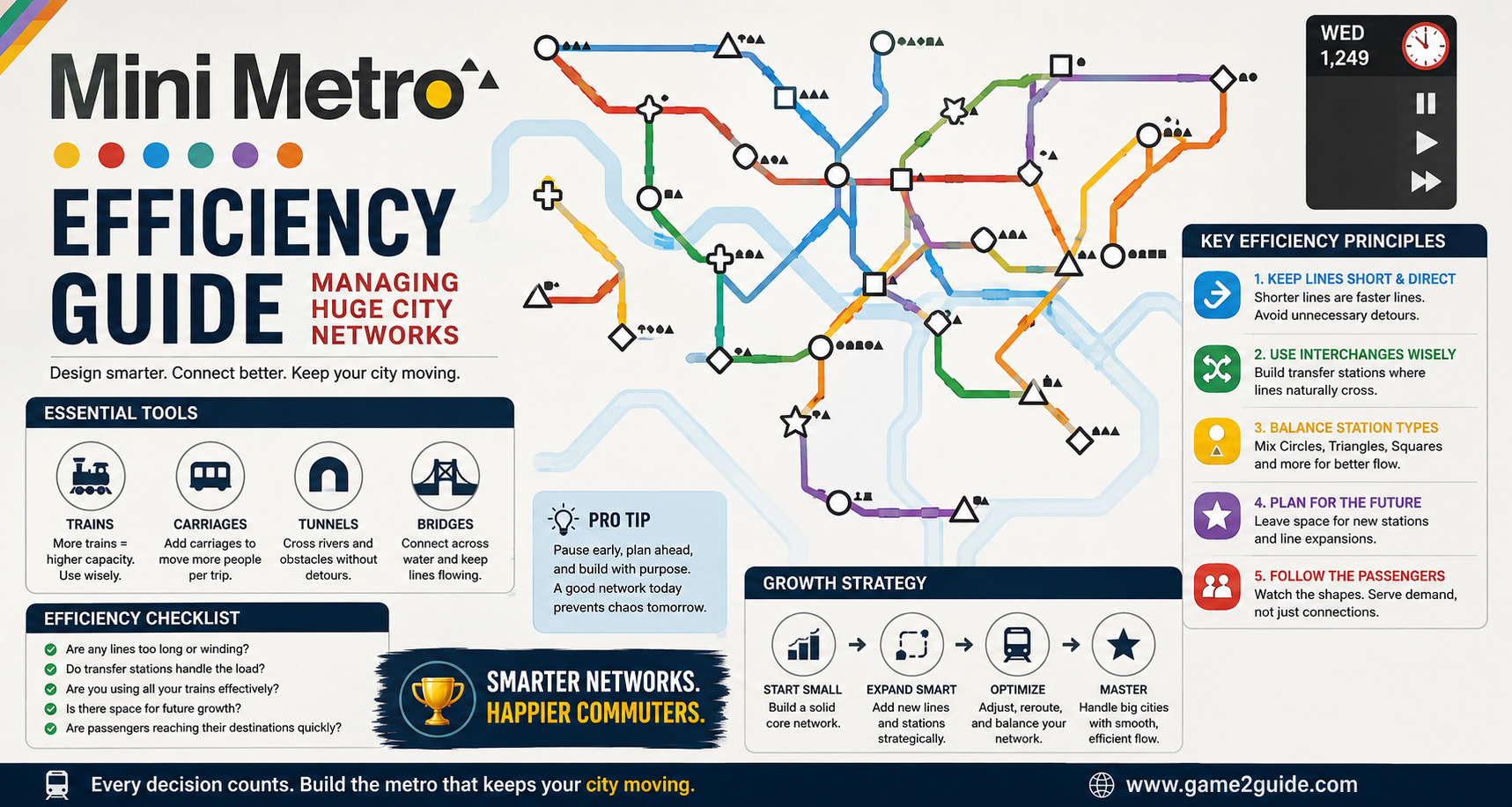
The first twenty minutes of a Mini Metro run feel calm and manageable, right up until a fourth or fifth line gets added and the whole network starts collapsing under passenger overflow. What worked fine for a small city grid completely falls apart once stations multiply and transfer points get overloaded, and that shift catches a lot of players off guard. This game have 4.65 stars, 1M+ downloads.
This Mini Metro efficiency guide breaks down the planning habits, line management techniques, and resource decisions that keep sprawling networks running smoothly instead of buckling the moment your city grows past its early, easy stage.
Why Small Networks Feel Easy and Big Ones Do Not
Early in a Mini Metro session, a couple of straightforward lines can handle passenger flow without much thought. The real difficulty shows up once stations multiply across a wider map and lines start crossing over each other constantly.
The core issue is rarely a lack of resources. It is usually a network design that worked fine at a small scale but was never built with growth in mind. A line that made perfect sense connecting four stations becomes a serious bottleneck once six more stations get added along the same stretch of city.
Efficient large networks are planned with future growth already in mind, not redesigned reactively every time a new station appears.
Planning Line Layouts Before Problems Appear
The single biggest factor separating smooth, high-scoring runs from chaotic collapses is how deliberately lines get planned rather than extended.
Group Stations by Geographic Clusters
Rather than stretching a single line across the entire map, group nearby stations into clusters served by shorter, more efficient lines. This reduces the distance trains travel per loop and keeps individual lines from becoming overloaded highways that every passenger relies on.
Reserve Straight Segments for High-Traffic Corridors
Straight line segments move trains faster than segments with sharp turns. Identify which corridors are likely to carry the heaviest passenger volume, usually between densely packed station clusters, and prioritize keeping those specific segments as straight as possible.
Managing Transfer Stations Without Creating Bottlenecks
Transfer stations, where multiple lines intersect, are where most large Mini Metro networks start to break down. Passengers pile up waiting for connecting trains, and a single overloaded transfer point can slow down an otherwise well-designed network significantly.
Here are practical ways to keep transfer points functioning smoothly:
- Avoid routing more than two or three lines through the same single station whenever possible, since each additional line increases congestion risk at that point
- Use interchange upgrades as soon as they become available at stations showing consistent passenger buildup, since they meaningfully increase capacity
- Spread transfer responsibility across multiple stations rather than relying on one central hub for the entire network, which reduces the impact if any single station becomes overloaded
- Monitor passenger shape icons at transfer stations closely, since a buildup of a specific shape usually signals a line combination that is not serving that connection efficiently
Resource Allocation for Growing Networks
Trains, carriages, and bridges are limited resources in Mini Metro, and how you allocate them matters just as much as line layout itself.
Prioritize Carriages on High-Volume Lines
Adding an extra carriage to your busiest line usually improves overall network efficiency more than adding an entirely new line with limited resources. A single well-supported line handling heavy traffic smoothly beats two thin, under-resourced lines competing for the same limited trains.
Save Bridges for Water Crossings That Unlock Major Shortcuts
Bridges are expensive resources, so use them specifically where they meaningfully shorten a route rather than wherever a river happens to be in the way. A bridge that saves a train several stations worth of travel time delivers a much bigger efficiency return than one used for a minor shortcut.
Reading Passenger Patterns to Stay Ahead of Growth
Efficient large networks are managed proactively, not reactively. Watching passenger behavior gives you early warning signs before a station actually becomes overwhelmed.
- Watch for stations with steadily increasing passenger icons over several game weeks, since this signals a growing demand that current lines are not meeting
- Pay attention to which passenger shapes consistently pile up at specific stations, since this often points to a missing or inefficient direct connection
- Track which lines carry the most passengers overall and prioritize resource upgrades toward them first
- Anticipate new station types appearing on the map edges and plan line extensions before they become urgent
Common Mistakes That Cause Networks to Collapse
Even experienced Mini Metro players lose otherwise strong runs because of a handful of repeated habits. Watch out for these:
- Extending existing lines indefinitely instead of adding new ones. A single line stretched too far becomes slow and prone to overcrowding, even with extra carriages added.
- Ignoring early signs of station overcrowding. Waiting until a station is visibly overwhelmed to respond usually means the damage has already started spreading to nearby stations.
- Overusing a single transfer hub for the entire network. This creates a fragile single point of failure that collapses the whole system if it becomes overloaded.
- Underinvesting in carriages while chasing new lines. More lines without adequate carriage support often creates more problems than it solves.
Cutting down on these mistakes alone tends to noticeably extend how long a network stays efficient before collapsing.
Long-Term Habits for Managing Huge City Networks
Players who consistently handle sprawling Mini Metro networks well tend to share a few habits that go beyond individual line decisions:
- Reviewing the entire network layout periodically rather than only reacting to the newest station
- Balancing resource investment between new lines and upgrades to existing ones
- Watching passenger shape trends closely to anticipate demand before it becomes a bottleneck
- Being willing to redesign a line completely rather than patching it repeatedly with minor adjustments
None of these habits require restarting a run constantly. They come down to treating network design as an ongoing process rather than a one-time setup.
FAQ: Managing Large Mini Metro Networks
What is the most common reason large Mini Metro networks collapse?
Overloaded transfer stations are usually the main culprit. When too many lines route through a single hub, congestion at that point can slow down the entire network rather than just one line.
Should I prioritize new lines or upgrading existing ones as my city grows?
Both matter, but adding carriages to your busiest existing lines often delivers more efficiency than launching a new, thinly resourced line. Balance new lines with adequate support for the ones you already have.
How many lines should pass through a single transfer station?
Keeping transfer stations to two or three lines whenever possible helps prevent congestion. Spreading transfer responsibility across multiple stations reduces the risk of one hub becoming a bottleneck.
When should I use a bridge instead of routing around water?
Save bridges specifically for crossings that create major shortcuts and noticeably reduce travel time. Using them for minor detours wastes a resource that could deliver a bigger efficiency gain elsewhere.