Friendship levels quietly gate some of the best content in Animal Crossing: Pocket Camp, yet plenty of players spend months barely scratching the surface with their favorite animals. This guide covers how to actually maximize friendship points in Animal Crossing: Pocket Camp, which activities give the best return, and why random gifting alone leaves a lot of progress on the table. This game has 4.39 stars, 10M+ downloads.
Pocket Camp sits comfortably in the life simulation category, built around a relaxed pace that still rewards a bit of strategy underneath the surface. Friendship levels unlock furniture, dialogue, and camper interactions that never appear otherwise, which makes understanding the system worth far more than casually tapping through requests.
The friendship system also ties directly into the game’s crafting and camper invitation mechanics, so treating it as a side activity rather than a core loop means missing out on rewards that quietly shape how your camp grows over time. A little intention here goes a long way toward getting the most out of every daily session.
Why Friendship Levels Matter More Than They Seem
Higher friendship levels unlock exclusive furniture rewards, deeper camper interactions, and access to content tied specifically to that animal’s storyline. Ignoring friendship progression means missing out on a meaningful chunk of the game’s actual content, not just a cosmetic detail.
It is a bit like a workplace relationship built purely on small talk versus one built on genuinely showing up for someone. Both technically count as a relationship, but only one actually unlocks trust and deeper conversation over time. Friendship points work the same way here.
What Actually Earns Friendship Points
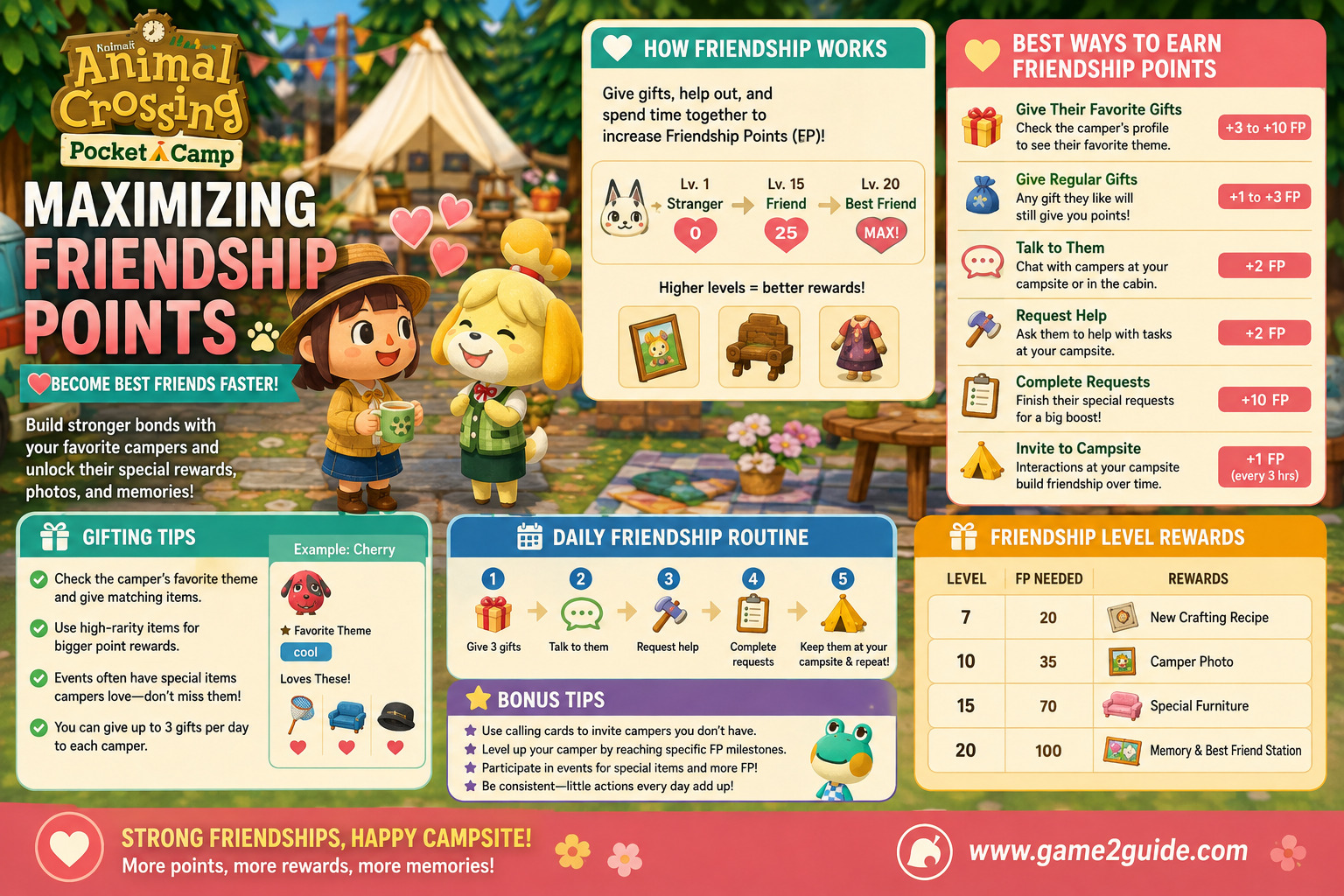
Before diving into strategy, it helps to know where points genuinely come from:
- Completing requests from campers, which scale in reward based on item rarity
- Gifting favorite items, which earns significantly more than generic gifts
- Photo sessions, a quick and often underused source of points
- Garden visits, when campers stop by your player’s garden
- Special events, which often include bonus friendship opportunities tied to specific animals
Prioritize Requests Over Random Gifting
Completing requests consistently earns more friendship points than simply handing over random items, and the reward scales further when the requested item happens to be one that camper particularly likes. Checking request boards regularly, rather than only when convenient, adds up significantly over time.
A Simple Daily Request Routine
- Check every camper’s request board during your first login of the day
- Prioritize requests using items you already have in inventory
- Craft or gather specifically for requests offering the best friendship reward
- Avoid ignoring smaller requests just because the reward looks modest
- Revisit boards again later in the day if new requests have appeared
This small daily habit consistently outperforms sporadic, larger gifting sessions spread further apart. Even a few minutes checking boards during a commute or a coffee break adds up over weeks, since consistency here matters more than any single big gifting session ever could.
Learn Each Camper’s Favorite Items
Every camper has specific item preferences, and gifting a favorite item earns noticeably more friendship points than a generic one. Spending a little time learning these preferences, rather than gifting whatever happens to be sitting in your inventory, meaningfully speeds up progression with animals you actually want to prioritize.
- Check camper profiles for hints about personality and preferences
- Track patterns in which gifts earn stronger reactions
- Save favorite items for campers you are actively trying to level up
- Avoid wasting favorite items on campers you are not currently prioritizing
This is one of those details that feels small in isolation but adds up significantly over dozens of gifting sessions. A player who consistently matches gifts to preferences will reach higher friendship levels noticeably faster than one gifting at random, even if both are putting in roughly the same amount of daily effort.
Do Not Skip Photo Sessions
Photo sessions are an easy source of friendship points that many players skip simply because they take a few extra taps. Making this a habit, rather than an afterthought, adds a small but consistent boost to friendship progression across your active campers.
A related area worth exploring alongside friendship building is garden customization, since a well-designed garden encourages more frequent camper visits, which indirectly supports steady friendship gains without requiring constant active attention. Building this into an existing routine, like snapping a photo right after checking request boards, keeps it from feeling like extra work while still adding up over time.
Focus on a Handful of Campers Instead of Everyone at Once
Spreading attention evenly across every camper in the game slows down meaningful progress with any of them. Picking a handful of favorites to focus on first, rather than trying to level up the entire roster simultaneously, gets you to the exclusive furniture and story content much faster.
- Choose three or four campers to prioritize initially
- Focus requests and gifting specifically toward this smaller group
- Expand your focus list gradually once early favorites reach higher levels
- Revisit neglected campers periodically, rather than abandoning them permanently
Think of it like studying for several subjects at once versus focusing deeply on two or three at a time. Splitting attention evenly feels fair, but it usually means nothing gets mastered quickly. Concentrating effort on a smaller group gets tangible results sooner, and those early wins tend to build momentum that carries into the rest of your roster later.
Stock Materials Ahead So Requests Never Sit Idle
One of the quieter reasons players stall out on friendship progress is running out of the crafting materials needed to fulfill higher-value requests. If a camper’s request calls for a crafted item you have not gathered the pieces for yet, that friendship opportunity effectively sits idle until you catch up.
A Simple Material Stockpiling Approach
Keeping a small buffer of common crafting materials on hand avoids this bottleneck entirely:
- Check which materials show up most often across current requests
- Prioritize gathering activities that produce those specific materials
- Keep a modest reserve rather than crafting items only as requests appear
- Rotate gathering focus as request patterns shift with new events or seasons
- Avoid spending your entire material stock on decoration crafting when requests are still outstanding
This habit turns request boards from something you react to into something you can act on immediately, which matters more than it sounds once you are trying to level up several campers at once.
Use the Camper Roster to Plan Longer-Term Goals
Beyond daily requests, Pocket Camp rewards players who think a few steps ahead about which campers unlock content they actually want. Some campers offer furniture sets tied to a particular theme, while others unlock story dialogue or camp visuals that only appear once a certain friendship threshold is crossed.
- Research reward furniture before committing heavily to a specific camper
- Balance aesthetic goals with genuine attachment to certain animals, since both matter for long-term motivation
- Track your progress toward the next meaningful reward tier rather than leveling up blindly
- Revisit your priority list periodically, since new content may shift which campers are worth focusing on next
A related area worth exploring alongside this planning is camp site design itself, since certain furniture rewards only make sense once you have a themed area ready to display them properly.
Special Events Offer Concentrated Friendship Opportunities
Limited-time events frequently include bonus friendship activities tied to specific animals, and missing these windows means waiting for a potential rotation that may not come back soon. Checking in during active events, even briefly, is one of the more efficient ways to boost friendship levels quickly for animals featured in that event.
Common Mistakes That Slow Down Friendship Progress
A handful of habits consistently show up among players stuck at lower friendship levels:
- Gifting randomly instead of learning camper preferences
- Skipping photo sessions because they feel like a minor extra step
- Spreading attention too thin across the entire camper roster at once
- Ignoring request boards for days at a time
- Missing special events tied to specific animals
- Running out of crafting materials, leaving valuable requests unfulfilled
- Leveling up campers without a plan, rather than prioritizing ones tied to rewards you actually want
Final Thoughts
Maximizing friendship points in Animal Crossing: Pocket Camp comes down to prioritizing requests daily, learning favorite items instead of gifting randomly, and focusing attention on a smaller group of campers rather than spreading effort too thin. Handle these habits consistently, and friendship levels climb steadily enough to unlock content that casual, unplanned play simply never reaches.
Frequently Asked Questions
What is the fastest way to earn friendship points in Pocket Camp?
Completing requests consistently, especially with favorite items, earns significantly more friendship points than random gifting alone.
Do photo sessions really help with friendship progress?
Yes. They are a quick, often overlooked source of points that adds up meaningfully when done regularly instead of skipped.
Should I try to level up every camper at the same time?
No. Focusing on three or four campers first gets you to exclusive furniture and content much faster than spreading attention evenly across the entire roster.
Are special events worth prioritizing for friendship points?
Yes, since they often include bonus friendship opportunities tied to specific animals that may not return again for a long time.
Why do my requests keep sitting unfulfilled?
This usually happens when you run out of the crafting materials a request needs. Keeping a small stockpile of commonly requested materials prevents this bottleneck.
About the Author